Income forecast
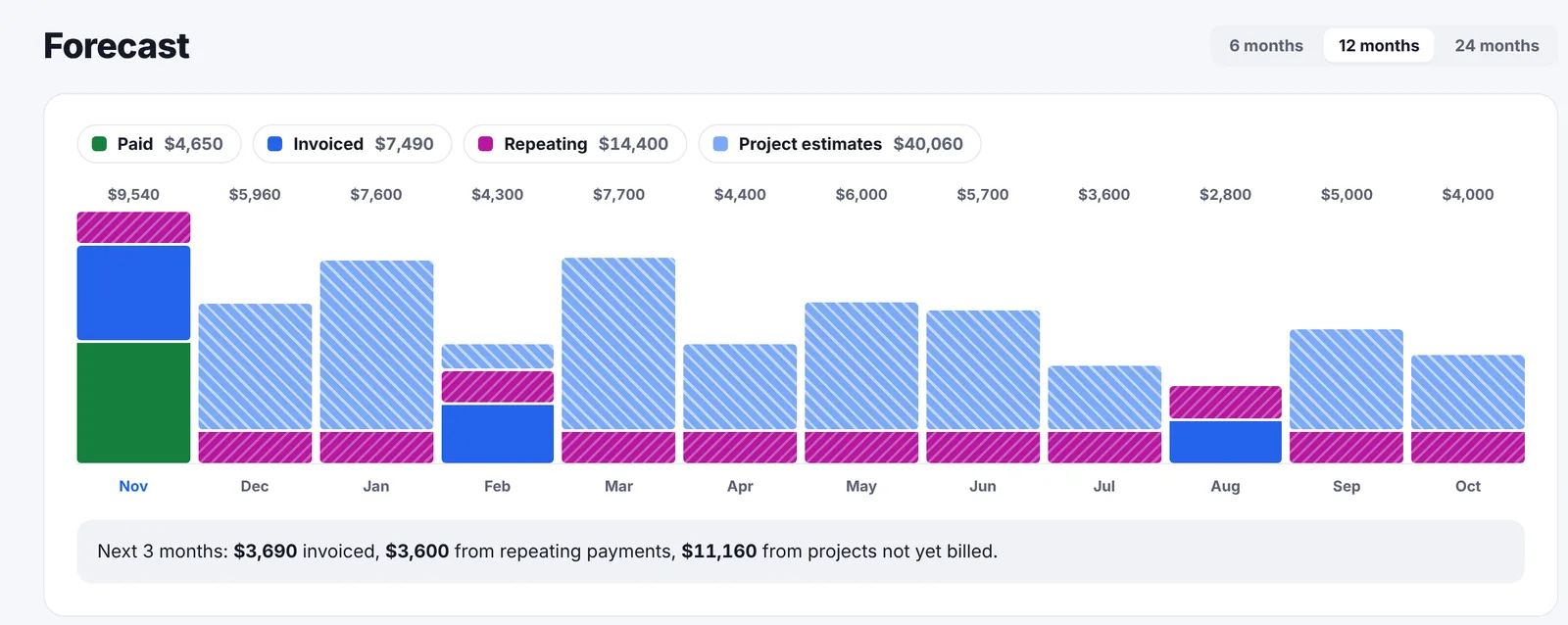
Six, twelve or twenty-four months ahead, a bar per month, and four layers that stay apart: paid, invoiced, repeating, and the value of projects nobody has billed yet.
Everything on this page is in the one plan at $14.99 a month.
Quick answer
Go Lancer builds a forecast from records you already have: paid invoices and payments, invoices still due, payments marked as recurring, and the unbilled value of open projects. Each month is a bar with those four layers stacked most certain at the bottom, over 6, 12 or 24 months. Any layer can be switched off, every month opens line by line, and a sentence underneath sums up the next three months with the layers still named separately.
Four layers, deliberately not added up
Freelance income is not one kind of money. The forecast keeps it in four:
- Paid. Money that arrived: paid invoices on the date they were paid, plus payments with no invoice behind them, such as a retainer or a deposit. It only appears in the current month and the past ones.
- Invoiced. Sent and still waiting, placed on the due date.
- Repeating. Standing arrangements projected forward.
- Project estimates. The remaining value of agreed work, placed on the month the project is due to end.
Adding them together would produce a number nobody could act on: an issued invoice is nearly certain, a retainer is likely, and a project that has not been billed is a guess. You can switch any layer off and watch the total fall, which is a quicker way of asking how bad it gets than any spreadsheet.
I want all my information in one space. A real central hub, not folders spread across five apps.
How repeating money is projected
Mark a payment as recurring and give it a frequency, and Go Lancer carries it forward at that rhythm: weekly, every two weeks, monthly, quarterly or yearly.
Two rules keep it honest. Only the most recent payment of a series projects, so a retainer you logged in three months running is counted once and not three times. And projection starts after the last occurrence that actually happened, so nothing is predicted for a date that already produced a real payment.
A monthly arrangement anchored to the 31st repeats on the 30th or the 28th rather than sliding into the following month.
What a project contributes
A project counts for its value minus whatever has already been invoiced against it. An $8,000 project with $3,000 billed puts $5,000 into the month it is due to end.
Four kinds of project are left out: completed ones, ones with no end date, ones with no value, and ones already invoiced in full. The forecast says how many were left out and why, with a link to fill in what is missing, because a forecast that silently drops half your work is worse than no forecast.
Opening a month
Click a month and it breaks into lines: each invoice, payment and project, with the date that placed it there. Every line says which date that was, whether it is paid on a date, due on a date, expected because something repeats monthly, or ending on a date. Clicking a line opens the record it came from.
Nothing in the forecast is a figure you have to take on trust. Every pound or dollar in it traces back to an invoice, a payment or a project.
The next three months, in a sentence
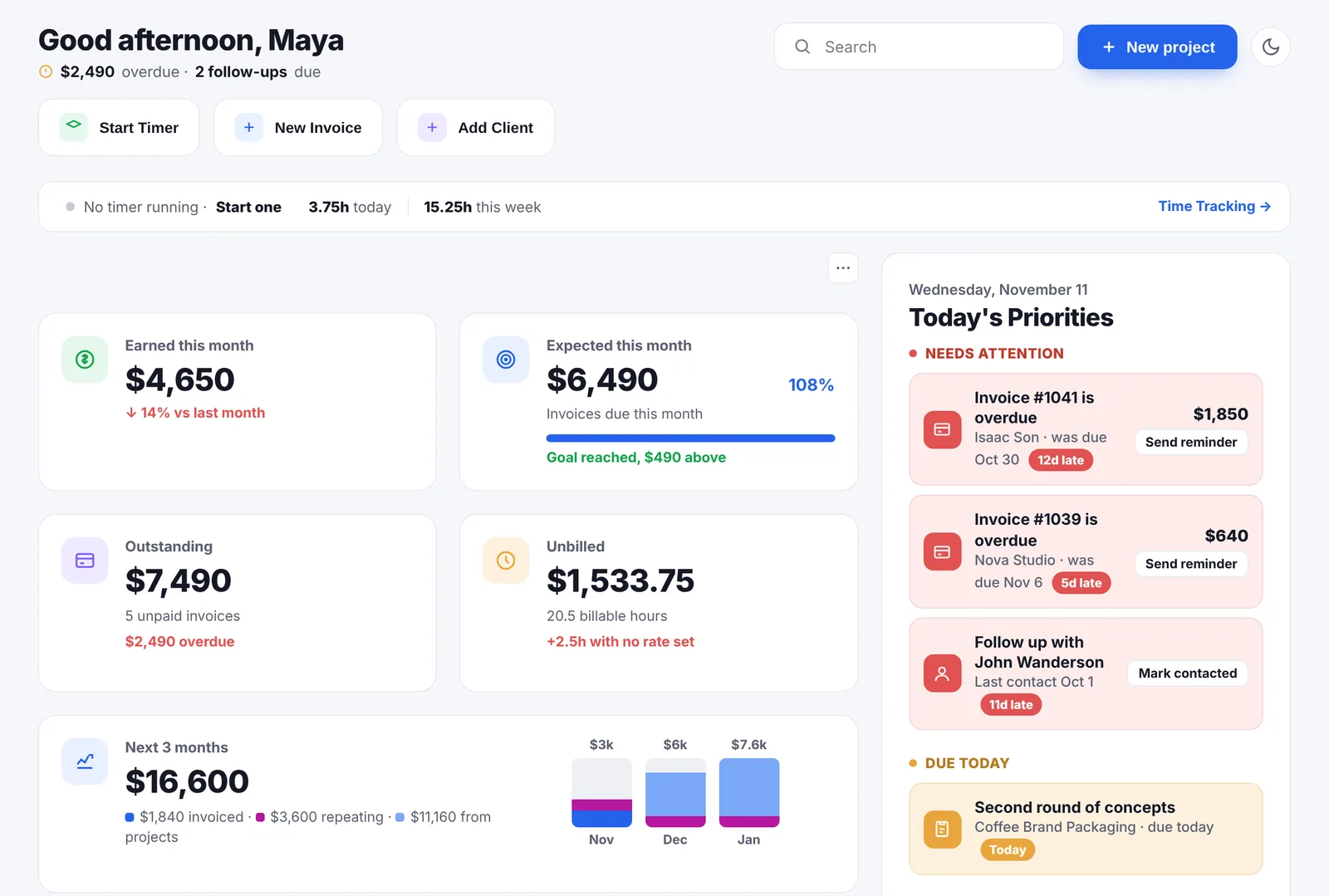
Under the chart is the line most freelancers actually read: what the next three months hold. The layers stay named apart, so much invoiced, so much from repeating payments, so much from projects not yet billed. The same figure sits on the dashboard as a tile, so you see it without opening anything.
Several currencies, one chart
Everything is converted into your account currency before it is added up, at ECB reference rates refreshed daily, the same conversion the rest of Go Lancer uses. A freelancer invoicing in euros, dollars and pounds gets one readable chart rather than three.
What the forecast does not do
- It does not guess. There is no model, no trend line and no seasonality. Every figure comes from a record you created.
- It does not count leads. A conversation that has not become a project with a value and an end date is not income yet.
- It is not a budget. It forecasts money coming in, not what you spend.
- It is not tax advice. For what to set aside, our tax calculator covers five countries.
Questions people ask
How far ahead does the forecast go?
Six, twelve or twenty-four months, starting with the current one. The choice is remembered, so the view you prefer is the one you get next time.
What are the four layers?
Paid, which is money that has arrived. Invoiced, which is sent and not yet paid, placed on its due date. Repeating, which is standing arrangements such as retainers projected forward. And project estimates, the value of agreed work not yet billed, placed on the project's end date.
Why not add them into one number?
Because they are not the same kind of money. An issued invoice is nearly certain, a retainer is likely, and an agreed project is a guess. A single blended figure hides which part you can count on, and that is the only part that pays rent.
Can I hide a layer?
Yes, each one switches off and the chart and totals follow. The last visible layer cannot be switched off, because an empty chart with no explanation looks broken rather than empty.
How are repeating payments projected?
From a payment you marked as recurring, at its own frequency: weekly, every two weeks, monthly, quarterly or yearly. Only the most recent payment of a series projects, so a retainer logged three months running is not counted three times, and projection starts after the last occurrence that already happened.
What happens on the 31st of a short month?
A monthly arrangement anchored to the 31st repeats on the 30th, or the 28th, rather than sliding into the month after.
How is a project's remaining value worked out?
Its value minus whatever has already been invoiced against it. If an $8,000 project has $3,000 billed, $5,000 sits in the month the project is due to end.
Which projects do not appear?
Completed ones, ones with no end date, ones with no value set, and ones already invoiced in full. The forecast says how many were left out and why, with a link to fill in what is missing.
What if my invoices are in different currencies?
Everything is converted to your account currency before it is added up, at ECB reference rates refreshed daily, the same conversion every other figure in Go Lancer uses.
Can I see what makes up a month?
Click the month and it opens line by line: each invoice, payment and project, with the date that put it in that month, whether that is a due date, a payment date or a project's end date. Clicking a line opens the record.
How far ahead can a freelancer realistically forecast?
One month is usually solid, three is a reasonable plan, and anything past six is a shape rather than a number. The point of keeping the layers apart is that you can read the certain part separately and treat the rest as the range it is.
Why should a freelancer forecast income at all?
Because the decisions that need the number come early: whether to take the badly paid job, whether to book a holiday, whether this is the month to raise rates. By the time a thin month arrives the choice is already gone.
What is cash flow forecasting?
Working out when money will arrive and when it will leave, month by month, so you can see a shortfall before you are in it. For a freelancer the incoming half is the hard one, because much of it depends on when clients decide to pay.
What is a recurring payment?
Money that arrives on a rhythm rather than once: a monthly retainer, a quarterly maintenance fee, an annual licence. It is the most predictable income a freelancer can have, which is why it sits in its own layer of the forecast.
Keep going
Dashboard Invoicing Projects and tasks Payment reminders How much to set aside for taxes Hourly rate calculator Compare with other apps About Go LancerSee what your next six months look like
Seven days, your own clients and invoices in it, and a founder who answers email. Then $14.99 a month, cancel any time.